
Resources
Resources are the entity-level part of the backend.
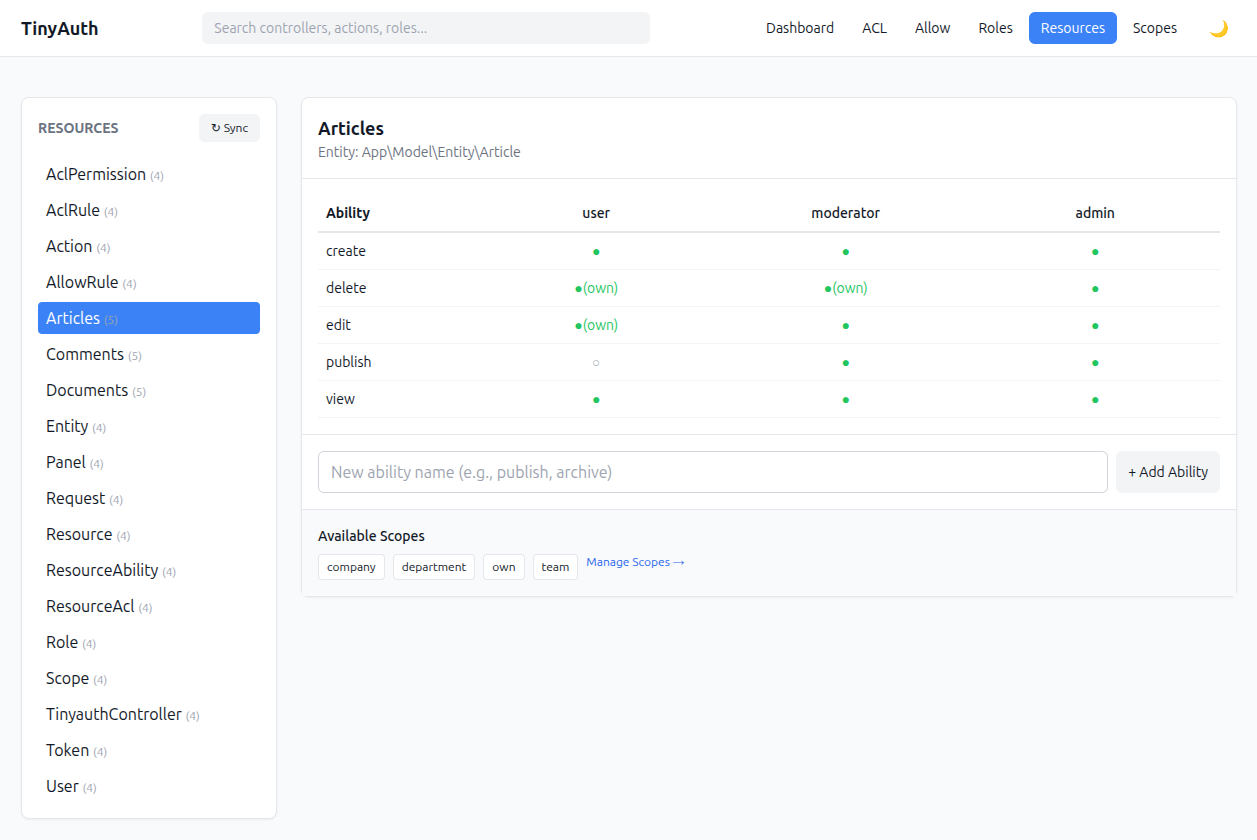
They answer questions like:
- "Can this user edit this article?"
- "Can moderators delete comments?"
- "Can users edit only their own records?"
Data model
- Resource — entity type, for example
Article - Ability — action on that resource, for example
view,edit,publish - Scope — optional field match, for example
article.user_id === user.id
Syncing resources
The backend can scan your entities and register them as resources. After running the migrations, use the sync UI at:
/admin/auth/sync/resourcesOr call ResourceSyncService directly.
Excluding plugins
Resource discovery respects TinyAuthBackend.excludedPlugins, so entities from plugins like DebugKit can be kept out of both sync results and the Resources admin section.
Synced resource names use the entity class basename, for example:
App\Model\Entity\Article→ArticleBlog\Model\Entity\Post→Post
Example schema
CREATE TABLE tinyauth_resources (
    id INT AUTO_INCREMENT PRIMARY KEY,
    name VARCHAR(100) NOT NULL UNIQUE,
    entity_class VARCHAR(200) NOT NULL,
    table_name VARCHAR(100) NOT NULL
);

CREATE TABLE tinyauth_resource_abilities (
    id INT AUTO_INCREMENT PRIMARY KEY,
    resource_id INT NOT NULL,
    name VARCHAR(50) NOT NULL
);

CREATE TABLE tinyauth_resource_acl (
    id INT AUTO_INCREMENT PRIMARY KEY,
    resource_ability_id INT NOT NULL,
    role_id INT NOT NULL,
    type VARCHAR(10) NOT NULL,
    scope_id INT NULL
);
Policy example
namespace App\Policy;

use App\Model\Entity\Article;
use Cake\Datasource\EntityInterface;
use TinyAuthBackend\Policy\TinyAuthPolicy;

class ArticlePolicy extends TinyAuthPolicy
{
    public function canPublish(EntityInterface $user, Article $article): bool
    {
        return $this->can($user, 'publish', $article);
    }
}
Or use TinyAuthPolicy as the default ORM policy if your rules are fully backend-driven. See Authorization Integration for the resolver setup that avoids writing one policy class per resource.
Direct service example
use TinyAuthBackend\Service\TinyAuthService;

$service = new TinyAuthService();

$canEdit = $service->canAccessResource($user, $article, 'edit');
$canCreate = $service->canPerformAbility($user, 'Article', 'create');
Scope example
If a scope named own uses:
entity_field = user_iduser_field = id
then this backend rule:
- role
user - resource
Article - ability
edit - scope
own
means:
$article->user_id === $user->idSee Scopes for the full scope model.
Interaction with role hierarchy
If role hierarchy is enabled:
- higher roles inherit lower-role resource permissions
- a direct rule on the current role wins over inherited rules
- inherited scoped rules also flow into
getScopeCondition()