
Association vs DB Foreign-Key Audit
Navigate to:
/test-helper/associationsAudits whether your declared table associations (belongsTo, hasMany, hasOne, belongsToMany) agree with the actual database foreign keys, in both directions, and flags a few related consistency problems. It is read-only: it never changes your schema or code, it only suggests copy-paste fixes.
App and first-party plugin tables are scanned by default; vendor tables can be folded in via the toggle on the matrix page.
What it checks
The audit runs in several layers.
Constraint layer (the core diff)
A symmetric diff between the foreign keys your associations imply and the foreign keys that actually exist in the database:
- an association whose owner column does not exist at all reports an error and suggests an
addColumn()migration line (a foreign key cannot be placed on a missing column) - an association whose column exists but has no matching DB foreign-key constraint reports a warning and suggests an
addForeignKey()migration line - a DB foreign key with no matching association, suggests the
belongsTo/hasManycall - a target/column disagreement between the two
Key-type layer
Compares each declared foreign key's column type against the referenced (primary) key:
- a different type family (e.g.
integerreferencinguuid) is an error and suggests achangeColumn()migration line aligning the column to its target - an owner key narrower than the referenced key (e.g.
integerreferencingbiginteger) is a warning because it cannot hold every referenced value; samechangeColumn()fix - matching non-integer keys are an info hint that integer keys are generally preferred
Silence the non-integer info hint with TestHelper.associationAudit.preferIntegerKeys => false (the error and narrowing warning still report).
NOTE
The key-type layer only applies to single-column foreign keys. Composite keys are diffed structurally but not type-checked.
Cascade-rule layer
Compares the ORM dependent intent of a hasMany/hasOne against the matching DB foreign key's ON DELETE rule (reported as info, since either side can legitimately own the cascade):
- a
dependentassociation whose DB FK usesON DELETE NO ACTIONwon't cascade a delete issued directly in SQL (outside the ORM). The audit suggests switching the FK toON DELETE CASCADE, preserving the existingON UPDATErule - a DB
ON DELETE CASCADEwith a non-dependentassociation means the ORM won't fire child callbacks. The audit suggests adding'dependent' => true, 'cascadeCallbacks' => true(both are needed;dependentalone uses a bulkdeleteAll()that skips child callbacks)
ON UPDATE has no ORM-level equivalent and is not compared.
Loose-column layer
Flags *_id columns that have neither a foreign-key constraint nor an association (reported as info). The built-in ignore list covers common polymorphic columns (foreign_id, parent_id, related_id); extend it via TestHelper.associationAudit.ignoreColumns.
Index-presence layer
Flags foreign-key-style columns that are not the leading column of any index (reported as info), because joins and lookups on them table-scan. This matters most on PostgreSQL, where a foreign-key constraint does not auto-create an index on the referencing column, and for loose *_id columns managed only at the ORM level.
A column counts as indexed only when it is the first (leading) column of some index or key: a regular index, a unique constraint, or the primary constraint. A column buried as a non-first member of a composite index does not count, since such an index cannot serve a lookup or join on that column alone. For a composite foreign key the first column is checked, and the suggested addIndex() covers all of the key's columns in order.
The candidates are the union of every foreign-key-semantic column the audit already knows: DB foreign keys, existing code-side association foreign keys, and loose *_id columns. The loose-column ignore list applies here too, and at most one finding is emitted per column even when it surfaces via several sources. Each finding suggests an addIndex() migration line, e.g.:
$table->addIndex(['post_id']);Silence the whole layer with TestHelper.associationAudit.checkIndexes => false, for apps where the heuristic is more noise than value (e.g. write-heavy or denormalized schemas, or tiny lookup tables that do not need the index).
Composite foreign keys
Multi-column (composite) foreign keys are fully diffed in the constraint layer, both for belongsTo/hasMany/hasOne and for belongsToMany junctions. Fix snippets render the columns as arrays and pin a non-default bindingKey, e.g.:
$table->addForeignKey(['tenant_id', 'company_id'], 'companies', ['tenant_id', 'id'], [
    'update' => 'NO_ACTION', 'delete' => 'NO_ACTION',
]);A composite association whose foreign-key columns and binding columns do not line up is reported as "not auto-verifiable" rather than guessed at. Composite keys are diffed structurally but not type-checked.
The matrix
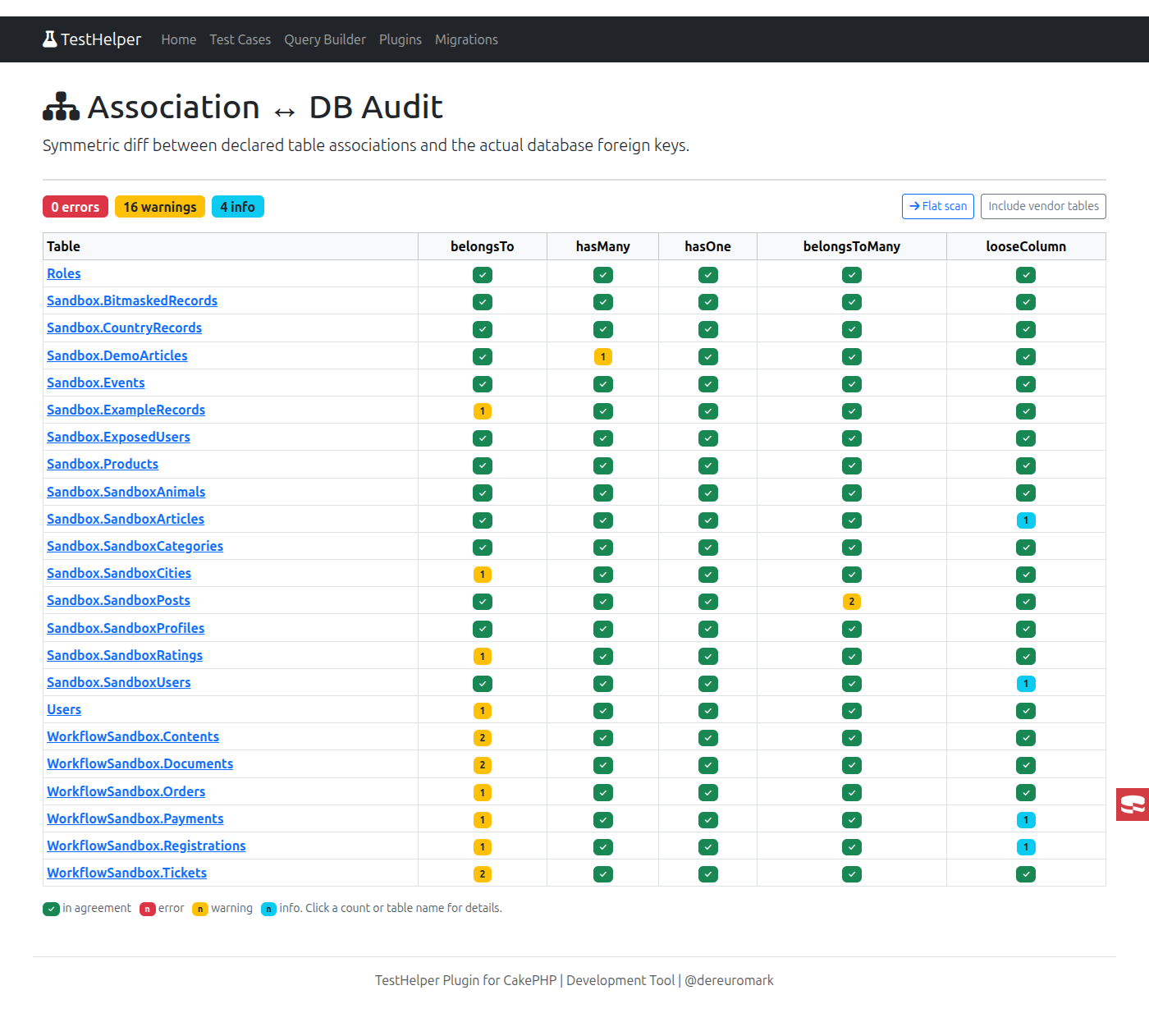
The summary matrix shows every table against each association type plus the cross-cutting layers (Key type, Cascade and Index) as their own columns, color-coded by status:
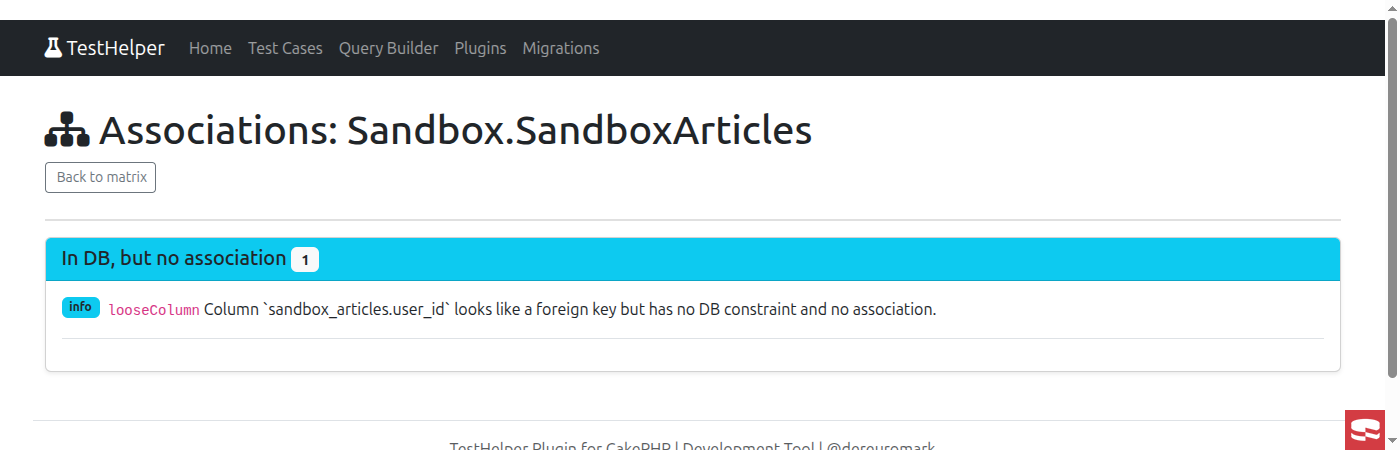
Each table opens to a per-direction detail view:
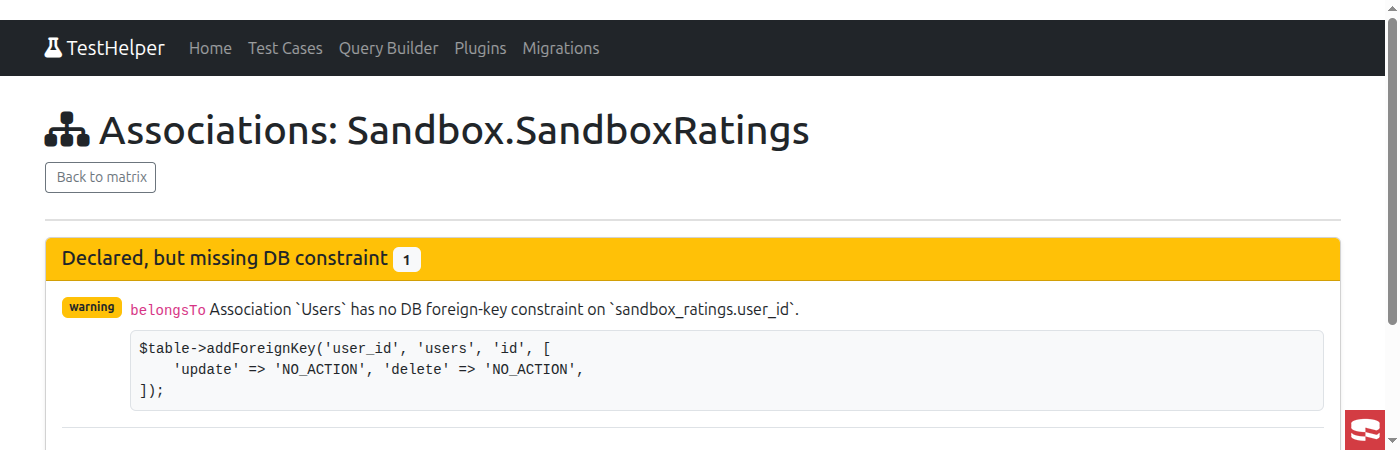
Every finding includes a copy-paste fix:
Flat scan
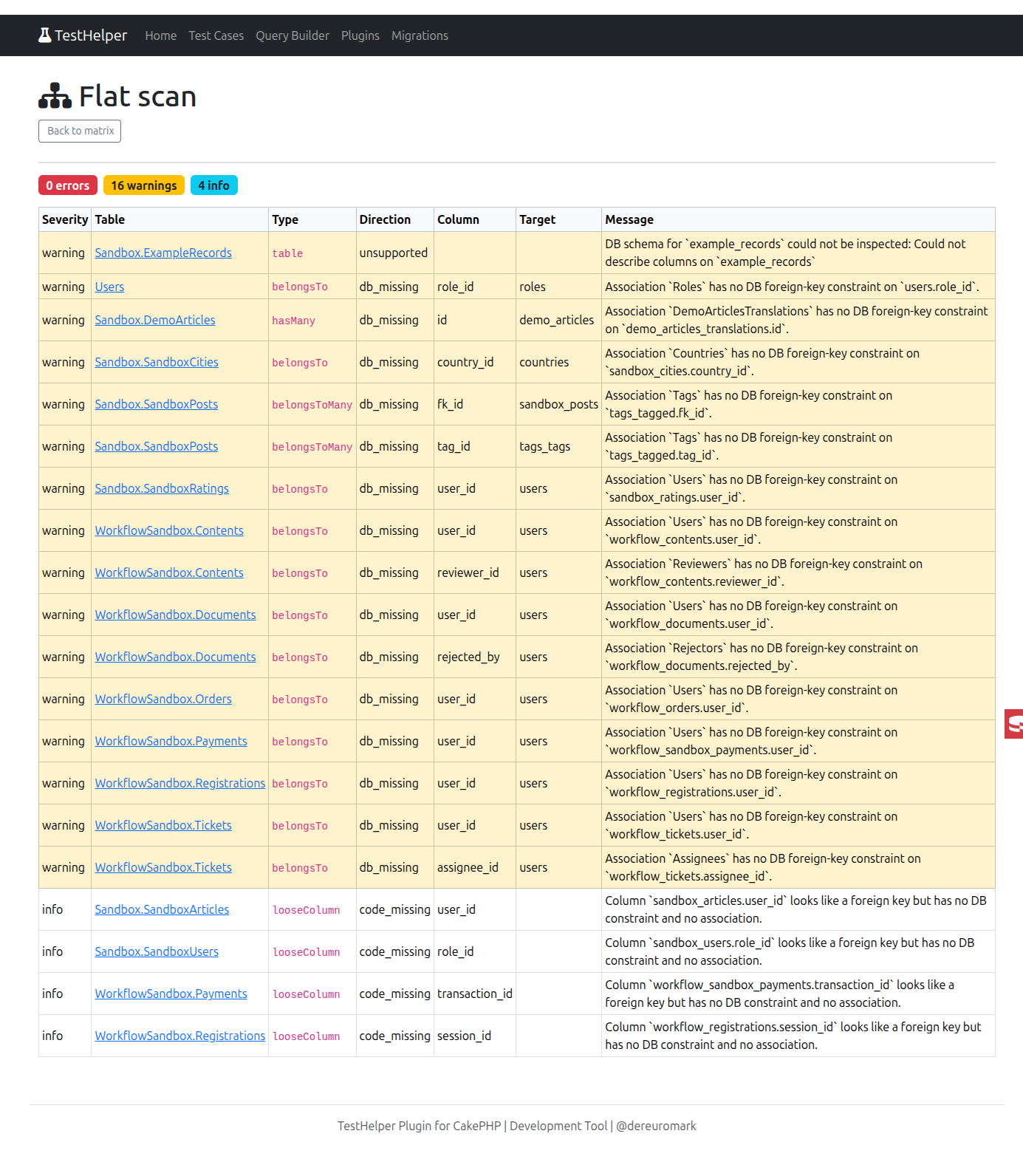
A flat scan lists every finding across all in-scope tables at once, ordered worst-first (errors, then warnings, then info) and grouped by table within each severity. Topic chips at the top (Constraints, Columns, Key types, Not verifiable) toggle whole categories of finding in or out, so you can mute, say, the not-verifiable noise and focus on real constraint problems:
Configuration
| Key | Default | Description |
|---|---|---|
TestHelper.associationAudit.ignoreColumns | [] | Column names to skip in the loose-column and key-type layers (merged with the built-in polymorphic defaults). Use for deliberately polymorphic string keys such as FileStorage's foreign_key, which legitimately holds integer owner ids. |
TestHelper.associationAudit.preferIntegerKeys | true | When false, suppress the "integer keys are preferred" info hint. Type-family errors and narrowing warnings still report. |
TestHelper.associationAudit.checkIndexes | true | When false, disable the index-presence layer entirely (no "foreign key with no index" info findings). |
See config/app.example.php for the canonical reference.
Limitations
ON UPDATErules are captured but not compared (no ORM equivalent).- Composite foreign keys are diffed structurally but not type-checked.
- A same-named table on a non-default connection cannot be disambiguated from its alias alone when drilling into the detail view.