
Healthcheck
The plugin provides a healthcheck stack that you can use to check the status of your application and its services. It runs both from the web and from the CLI.
| Web | CLI |
|---|---|
 | 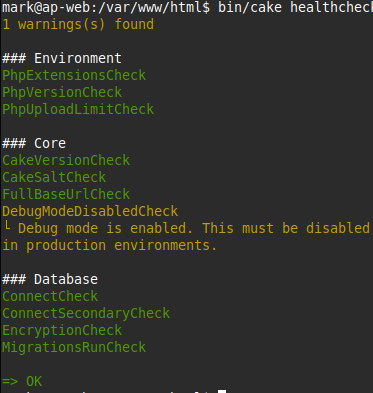 |
With -v in CLI you can also see all the detail information.
Configuration
The simplest way to configure the checks is via the Setup.Healthcheck.checks Configure key:
'Setup' => [
    'Healthcheck' => [
        'checks' => [
            \Setup\Healthcheck\Check\Environment\PhpVersionCheck::class,
            \Setup\Healthcheck\Check\Core\CakeVersionCheck::class,
            // ...
        ],
    ],
],
Once defined, this replaces the defaults. You can also use the Setup.Healthcheck.checks config to add your own checks.
Merging with the defaults
To replace only the ones you need, merge with the defaults:
'Setup' => [
    'Healthcheck' => [
        'checks' => [
            \Setup\Healthcheck\Check\Environment\PhpUploadLimitCheck::class => [
                'min' => 64,
            ],
            // ...
        ] + \Setup\Healthcheck\HealthcheckCollector::defaultChecks(),
    ],
],
If you need to pass config to a check, make sure the value is an array whose keys match the parameter names.
Passing instances
You can pass an instance of a check class instead of the class-name string when needed:
'Setup' => [
    'Healthcheck' => [
        'checks' => [
            new \Setup\Healthcheck\Check\Core\CakeVersionCheck(
                overrideComparisonChar: '^',
            ),
            // ...
        ],
    ],
],
Priority
You can set a priority (1...10) for each check to control the execution order:
protected int $priority = 6;The higher the priority (towards 1), the earlier the check runs.
Scope
If you want to set a specific scope, adjust the property directly or define the method. The method form is needed for a dynamic scope through a closure:
    /**
     * @return array<string|callable>
     */
    public function scope(): array {
        return [
            // Only run in debug mode
            function () {
                return Configure::read('debug');
            },
        ];
    }
Adjusting checks at runtime
To adjust an existing check at runtime, instantiate it first:
$check = new \Setup\Healthcheck\Check\Core\CakeVersionCheck();
$check
    ->adjustPriority(6)
    ->adjustScope([...]);
Usage
Access the /setup/healthcheck endpoint in your application to view the healthcheck. In debug mode you can see issues in detail; in production mode only the status is shown.
For CLI, run the command:
bin/cake healthcheckScheduled monitoring
You can write a queue task to run the healthcheck periodically — logging the results or alerting the admins directly on errors. With the QueueScheduler plugin you can add a scheduled task for it from the backend, for example every hour.
Default checks
The following checks are included by default.
Environment checks
- PhpVersionCheck: Validates the PHP version meets requirements.
- PhpExtensionsCheck: Checks that required PHP extensions are loaded.
- PhpUploadLimitCheck: Validates the
upload_max_filesizesetting. - MemoryLimitCheck: Checks that the PHP
memory_limitis adequate. - MaxExecutionTimeCheck: Validates the
max_execution_timesetting. - MaxInputVarsCheck: Checks the
max_input_varslimit. - TimezoneCheck: Validates the timezone configuration.
- OpcacheEnabledCheck: Checks that OPcache is enabled in production.
- RealpathCacheCheck: Validates the realpath cache settings.
- XdebugDisabledCheck: Warns if Xdebug is enabled in production.
- AssertionsCheck: Checks assertion settings for production.
- PhpErrorDisplayCheck: Validates that
display_errorsis off in production. - ExposePhpCheck: Checks that
expose_phpis disabled. - AllowUrlIncludeCheck: Validates that
allow_url_includeis off. - DisableFunctionsCheck: Checks that dangerous functions are disabled.
Core/application checks
- CakeVersionCheck: Validates the CakePHP version.
- CakeSaltCheck: Ensures the security salt is properly configured.
- CakeCacheCheck: Validates that cache configurations are set up.
- FullBaseUrlCheck: Validates the
App.fullBaseUrlconfiguration. - DebugModeDisabledCheck: Warns if debug mode is on in production.
- DebugKitDisabledCheck: Checks that DebugKit is disabled in production.
- SessionLifetimeCheck: Validates session lifetime settings.
- SessionCleanupCheck: Checks session garbage-collection settings.
- FilePermissionsCheck: Validates that
tmp/andlogs/are writable. - ComposerOptimizationCheck: Checks that the Composer autoloader is optimized.
- SecurityHeadersCheck: Validates security-related HTTP headers.
- CookieSecurityCheck: Checks cookie security settings (Secure, HttpOnly, SameSite).
Database checks
- ConnectCheck: Validates the database connection.
- DatabaseCharsetCheck: Checks the database charset/collation settings.
Opt-in checks
The following checks are available but not enabled by default, due to specific requirements or potential side effects.
Environment checks
- DiskSpaceCheck: Monitors disk usage with configurable thresholds (warning at 80%, error at 95%). Not enabled by default because disk paths and thresholds are environment-specific.
'Setup' => [
    'Healthcheck' => [
        'checks' => [
            \Setup\Healthcheck\Check\Environment\DiskSpaceCheck::class => [],
            // Or with custom thresholds and paths:
            \Setup\Healthcheck\Check\Environment\DiskSpaceCheck::class => [
                'warningThresholdPercent' => 70,
                'errorThresholdPercent' => 90,
            ],
        ] + \Setup\Healthcheck\HealthcheckCollector::defaultChecks(),
    ],
],
Network checks
- SslCertificateExpiryCheck: Checks the SSL certificate expiry for the application's host. Web-only (not available in CLI). Not enabled by default because it requires network access and may not apply to local/non-SSL environments.
'Setup' => [
    'Healthcheck' => [
        'checks' => [
            \Setup\Healthcheck\Check\Network\SslCertificateExpiryCheck::class => [],
            // Or with custom thresholds:
            \Setup\Healthcheck\Check\Network\SslCertificateExpiryCheck::class => [
                'warningDays' => 60,
                'errorDays' => 14,
                'host' => 'api.example.com',
            ],
        ] + \Setup\Healthcheck\HealthcheckCollector::defaultChecks(),
    ],
],
Creating custom checks
You can create your own checks by implementing Setup\Healthcheck\Check\CheckInterface (or extending AbstractCheck):
namespace App\Healthcheck\Check;

use Setup\Healthcheck\Check\AbstractCheck;
use Setup\Healthcheck\HealthcheckResult;

class MyCustomCheck extends AbstractCheck {

    public function run(): HealthcheckResult {
        // Your check logic here
        if ($everythingOk) {
            return HealthcheckResult::success('All good!');
        }

        return HealthcheckResult::error('Something is wrong');
    }

    public function name(): string {
        return 'My Custom Check';
    }

    public function domain(): string {
        return 'Application';
    }

}
Then add it to your configuration:
'Setup' => [
    'Healthcheck' => [
        'checks' => [
            \App\Healthcheck\Check\MyCustomCheck::class,
        ] + \Setup\Healthcheck\HealthcheckCollector::defaultChecks(),
    ],
],
See also
- Maintenance Mode — whitelist the healthcheck endpoint during maintenance.
- Uptime — a simpler uptime route.